
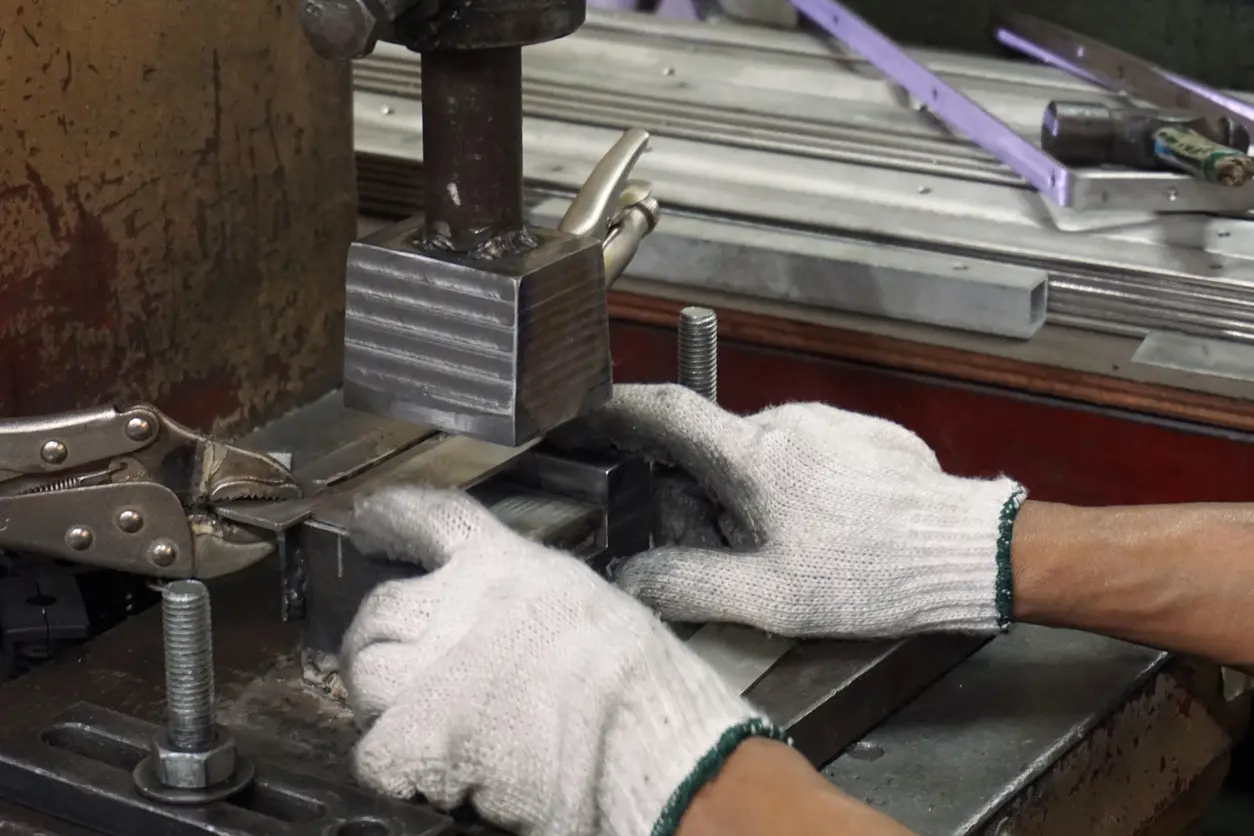
Here’s something many program managers and purchasers don’t realize. The quality of a stamped metal part depends on just as much on the die as it does on the press. An expertly designed tool runs reliably for years. A poorly built one creates headaches with every run.
That’s why at Jordan Manufacturing handles die-design in house. Read on to discover the stamping design considerations our team evaluates for every project and how they lead to better parts. To learn how we put these principles into practice, speak to a member of our team about our capabilities and equipment.
Process-Focused Dimensions and Tolerances
Tolerances are one of the most important stamping design considerations since how a part is dimensioned not only influences tooling costs; it communicates nonnegotiable requirements to our die builders.
Punches, Pierced, and Blanked Features
A punched edge isn’t perfectly straight. The top portion shears cleanly, while the lower portion fractures and breaks away at a slight angle. Because of that taper, dimensions for these features should reference the sheared edge. For a hole or other inside feature, our team measures at the highest point of the shear. Outside features get measured at their widest point.
If your application can’t tolerate any taper, secondary operations such as shaving can create a straighter edge. This increases overall cost, so it is best reserved for features where edge quality makes a difference in part performance.
Formed Features
Bends introduce additional variables. As a rule, reference dimensions for formed features from the inside surface and account for bend variation when locating features beyond the bend. Each bend has some angular variation, often about one degree in either direction. The farther a hole or tab is from the bend line, the greater the effect on its final position. Tolerance should account for both variables.
Multiple bends add complexity because variation from each bend can accumulate quickly. Referencing critical features to a common datum helps control this stack-up.
Take a Practical Approach
Tight tolerance remains essential for features that affect fit or function. Allow more flexibility elsewhere to maintain part performance and reduce tooling construction and maintenance costs.
Account for Burrs and Edge Conditions
All punched edges have a burr side. Indicating burr direction on your drawing allows us to orient the part so sharp edges land where they cause the least trouble. Will people handle the part by hand? Does it mate against a seal? Note it in the design. Deburring techniques, like tumbling, can always be added, but knowing your application requirements upfront helps minimize overhead.
Simplify Geometry Wherever Possible
While complex geometries are not off limits, simpler is almost always more cost-effective. Sharp internal corners concentrate stress, which accelerates tooling wear, so add small radii wherever possible.
Deep draws may require several forming stages, and narrow tabs or thin webs can tear or buckle. Could a single format component replace a welded assembly? Could two parts become one? Questions like these can unlock significant, but substantial, cost savings.
Call Jordan Manufacturing for More Stamping Design Considerations
Good part design and good die design go hand in hand. When stamping design considerations influence the tooling from day one, parts come out stronger and cost less to produce.
Have a part in mind? Give Jordan Manufacturing a call. Our tool designers review your part requirements and build the die around its exact specifications. Because our capabilities also include running and maintaining that tooling, nothing gets lost in a handoff between facilities. Start the conversation today and for a true manufacturing partnership, not just a transactional job.